- “My Quilt Project at Hasbro Children’s Hospital,” by Sydney Chon (Advisor: Daniel Stupar)
- “Emerging Markets, Emerging Perspectives,” by Andrea Fuentes and Lara Gamaledin (Advisor: Barrett Hazeltine)
- “Final Commencement Speech,” by Rishika Kartik
- “Creating a GISP,” by Julia Krausz (Advisor: Daniel Harris)
- “Reflections on being a mentor,” by Neva Mathew (Advisor: Janet Isserlis)
- “You should take my job when I graduate: Reflections from a CRCer,” by Hannah Stoch (Advisor: Janet Isserlis)
- “Making Learning Visible (It’s Not a TED Talk),” by Peggy Chang
My Quilt Project at Hasbro Children’s Hospital
Sydney Chon
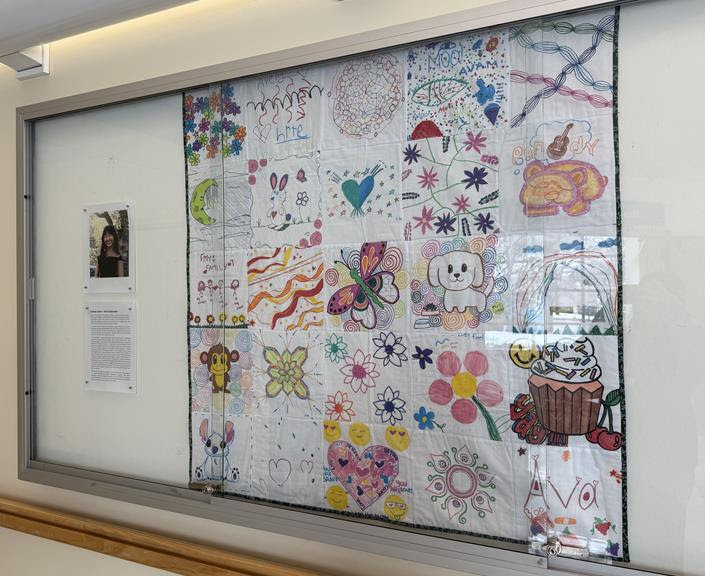
Art is my favorite form of storytelling. Creating art offers an intimate window into our own experiences and the lives of others, often sparking meaningful conversations without words. I have practiced art since elementary school and continue to do so now as a college senior and Healing Arts volunteer at Hasbro Children’s Hospital.
In the fall of 2023, I began volunteering at Hasbro. During my first year, I supported children through bedside arts-and-crafts activities. Each child’s creativity and talent continually inspired me, yet I realized their artwork was often seen only by a few people. I wanted to find a way to share their creativity with the entire hospital community.
In September 2025, I launched the Quilt Project with the vision of creating a large-scale community art initiative that would showcase the many talented patients and artists at Hasbro Children's Hospital. Each week from September through December, I visited the 4th and 6th floors to invite patients and their loved ones to participate. Those who were interested received a fabric square, with complete creative freedom to design anything they wished. While some patients chose to keep their work, many others generously shared their pieces for inclusion in the collective art piece.
The Quilt Project is, at its core, a community effort. Every square was created by Hasbro patients, family members, friends, and staff. Even the construction of the quilt itself is collaborative. This was my first time making a quilt, and it would not have been possible without the generosity, knowledge, and guidance of my neighbors in Houston, Texas, Mr. and Mrs. Hornbeak. As master quilters, they taught me how to use a sewing machine, piece the fabric squares together, layer the quilt with backing, and hand-stitch its border.
Through this process, the importance of community—of working together to create something beautiful, celebrating creativity and artistic expression—has been deeply reinforced. I am truly grateful to everyone who contributed to this quilt, and I hope that all who pass it are reminded of their vital role and value within this community.

Leave a comment.

Back to Blog list
Emerging Markets, Emerging Perspectives
Andrea Fuentes and Lara Gamaledin, Co-facilitators of the Group Independent Study Project Profits to Progress: Private Ventures in Emerging Markets
Some of the most creative solutions to poverty we have ever seen came from people trying to make money. It is not the version of development that fills most syllabi, and it was not the version we were finding in our courses at Brown.
Coming from Cairo and Mexico City, we were skeptical of top-down approaches to development, shaped by environments where solutions usually came from adapting to local constraints. Growing up surrounded by informal markets and businesses that out-competed multinationals simply by understanding their context better, we had both developed a skepticism toward the idea that the public sector held all the answers. The course took that intuition and tried to work through it more systematically, focusing on when and why market-driven solutions succeed in emerging markets, and where their limits become clear.
Our approach to building the syllabus started with the firm, and studying how businesses enter emerging markets, navigate institutional voids, and create demand. We then zoomed out to the forces shaping the markets, including trade wars, Belt and Road, BRICS, de-dollarization, impact investing, and the conditions under which public and private interests actually align. Inspired by the Harvard Business School teaching model, we relied on case studies to structure discussions around real decisions and trade-offs. With a 20-person class representing 14 countries, many of which were themselves emerging markets, the discussion rarely stayed theoretical for long. Students brought in their own experiences, adding context, and complicating assumptions we hadn’t thought to question.
Our guest speakers were drawn from across the industries we had examined during the first half of the semester. A managing director at Blackstone, the CEO of Latin America's largest cinema chain, a managing director at Endeavor, a partner at McKinsey, a fund investor in one of Africa's fastest fintech’s, a hedge fund CIO, and an academic studying how economic ideas spread across borders, each had navigated these markets differently. What stood out was how much their perspectives were shaped by those roles. An investor’s instinct to weigh risk and scalability came through differently than an operator’s focus on execution, just as an academic’s search for patterns that generalize diverged from a fund manager’s sensitivity to what makes each market structurally distinct. Each conversation opened up conversations that the readings alone never would have.
That two undergraduates could identify a gap, build a course around it, and spend a semester working through it with twenty students from fourteen countries is, in the end, an argument for the Open Curriculum as much as anything else.

Leave a comment.

Back to Blog list
Final Commencement Speech
Rishika Kartik
This piece attempts to capture the essence of Brown. It is about how Brown has the courage to embrace contradictions, including my favorite contradiction: think for yourself, but never walk alone. I would love to share what I wrote with the community :).
Brown is a constellation of contradictions. Talk to any Brown student, and you’ll find a Mary Poppins bag. A bottomless pit of interests and accomplishments that make less sense the longer you listen. The biology whiz kid is also an aerial acrobat. The ROTC triathlete is also a nonfiction author. The International Math Olympiad medalist has also interviewed Nigeria's former President. (All true stories by the way). I came to Brown as a person full of contradictions. An artistic scientist, a metalhead cellist, and a highly impulsive overthinker. Am I gonna fit in? Am I too strange? But I soon discovered that at Brown, we aren’t strange. We’re… “inter-disciplinary.” We channel our strangeness into action and find courage in contradiction. At the heart of the Brown experience is one particular contradiction: think for yourself – but never walk alone. We are encouraged to think for ourselves by virtue of the Open Curriculum. We choose every class we take. It’s basically a badge of honor here to say that you’ve taken classes from as many departments as possible. We aren’t forced to combine disciplines—we aren’t forced to do anything. But almost everyone does. Why? We do it because we’re driven by curiosity, the aim to understand the world in all its complexity, and the desire to improve our little corner of it.

The Open Curriculum allowed me to think for myself. I created my own concentration: Accessible Design. This aims to develop better systems for the 1 in 6 people worldwide who live with disability. 1 in 6. Most of the world is designed for the average user. But Accessible Design starts with people the bell curve typically leaves out and redesigns systems for them. This approach, which reframes disability as diversity, has led to some of our best innovations. Did you know that Siri, closed captions, and the potato peeler were initially designed to address accessibility needs? When we empower those who have historically been left behind, we tend to design better systems for everyone.

Which brings me to the second half of the contradiction: never walk alone. During my sophomore year, I learned this lesson the hard way. I’m walking home at night–alone–and hiding in the shadows is a large pothole, eagerly awaiting my downfall. I lock eyes with it for a moment, but it’s too late. The pothole won. I’m on the ground immediately, with a sprain bad enough to need crutches. But at Brown, people will always pick you up when you fall. Within minutes, I’m limping alongside an entourage of random strangers-turned-friends, who usher me into the Ratty and serve me a Michelin-worthy, elegantly plated three-course meal. Seriously. French fries with a swirl of ketchup for hors d’oeuvres, roasted chicken over seasoned rice for the main course, and, of course, a soft-serve sundae to finish it off. And it didn’t even end there. We shared stories, became friends, and went back to the Ratty every week for “pothole family potlucks.” Helping a stranger up is basic courtesy, of course. But this? This was anything but basic. This was extra, in the most Brown way possible. We all have stories like this. And that’s why “collaborative” is the first word people use when they talk about our university. It’s the reason that a viral Instagram reel anointed us “the happiest college on earth.” Because, above all, we value each other. We know that the more we invest in the people around us, the more we learn, and the better we become.

Never was the importance of solidarity more evident than in December. But true to Brown, when things fall apart, we come together. I was in the Ratty during the lockdown. And staff members fed us hot meals and reassured us, despite the terror on their own faces. Heartbroken alumni organized support events across cities, and shattered students mobilized to help affected families. Afterward, I kept seeing two words: Ever True. On post-it notes, t-shirts, and social media hashtags: Ever True was everywhere. But what feels current is, in fact, historic. The phrase “Ever True” comes from our school’s fight song, written by Donald Jackson way back in 1905. Anyone who has spent any time here will tell you Brown is far from traditional. And yet, we maintain a centuries-long tradition. Courage. It has taken immense courage for us to get here today. Some of us are the first in our families to attend college, or to attend college in the US. Many of us balanced work or family responsibilities with deadlines and extracurriculars. All of us have sacrificed comfort, certainty, and yes, a bit too much sleep, to pursue our dreams.

And here’s the final contradiction: Our fight song calls for unwavering strength, but we are unafraid to be sensitive. To be Ever True is to be soft yet strong. Tender yet tenacious. Vulnerable yet valiant. As we move forward, we carry with us a sense that we can live life like the Open Curriculum. We will form our own opinions and chart our own paths, while knowing that we will never walk alone. Life may pressure us to simplify: to let the very core parts of who we are fade away. We can’t let it. The world doesn’t need fewer contradictions. It needs people like us. Who finds peace in paradox. Create harmony in contrast. Carry courage in contradiction. And remain...Ever True.

Leave a comment.

Back to Blog list
Creating a GISP
Julia Figueiredo Krausz
I’m a senior concentrating in Chemical Engineering and one of the CRC's Independent Studies Coordinators. Throughout my time at Brown, I’ve become fascinated by sustainable food systems and food technology. I've been curious about how science, policy, and engineering can come together to make food systems more sustainable, and thanks to the GISP program, I was able to bring that passion into the classroom and create a space where students could explore the future of food together.
Co-Designing and co-leading "The Future of Food: Understanding Alternative Proteins" was one of the most meaningful experiences I’ve had at Brown. We studied everything from cultivated meat and fermentation-derived dairy to food policy and entrepreneurship. We hosted guest lectures by founders and researchers from around the world, connected with other students at the Food 4 Thought Festival, and saw how food technology can be applied to creating a better future for food. More than anything, it showed me that learning at Brown doesn’t have to stay within the boundaries of existing courses since we have the resources to build something entirely our own.
If you’ve ever wished you could study something that isn’t yet offered, I highly encourage you to apply for a GISP/ISP. It’s your chance to turn a personal interest into a credit-bearing academic project, work closely with faculty, and take real ownership of your education.

Leave a comment.

Back to Blog list
Reflections on being a mentor
Neva Mathew
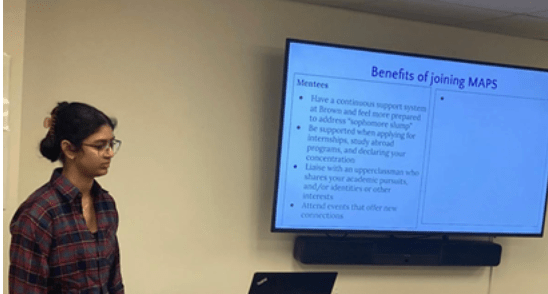
Walking into the CRC for the first time can feel a little uncertain, especially if you’re not quite sure what mentoring actually looks like beyond the description on a website. But for many mentors, it often started with a small moment of curiosity. Zoe, for example, hadn’t even heard much about the CRC until an email from Peggy about the IC program caught her attention. What stuck wasn’t just the opportunity itself, but the idea of being part of a community where people openly explore their interests and goals. For her, mentoring became a natural extension of that, combining her love of writing and connecting with people to help others pursue what excites them.
For others, mentoring is rooted in gratitude. Neva describes being inspired by an unofficial mentor who became a steady source of guidance throughout college. That experience shaped how she now approaches mentoring: as a way to offer that same kind of support to someone else. Mmesoma shares a similar perspective, grounded in her previous work with pre-health students. After going through so many formative experiences in college, she found herself asking a simple question: What’s the point of it all if you don’t share it? Mentoring, for her, is a way to make those experiences meaningful, not just personally, but for someone else navigating a similar path.
One of the most surprising lessons mentors mention is just how much their words can matter. Mmesoma reflected on how easy it is to jump straight into giving advice, but also how important it is to pause. Sometimes, mentees aren’t looking for answers as much as they’re looking for space to think out loud. Realizing that your influence is bigger than you expect can shift how you show up in those conversations. It becomes less about having the “right” answer and more about helping someone arrive at their own.
So what does mentoring actually look like? A typical meeting starts simply: introductions, a few questions, and maybe sharing a bit about your own path to help things feel more relaxed. From there, it’s really up to the mentee. Conversations can range from picking classes and finding research opportunities to talking through career goals or just figuring out how to navigate life at Brown. Over time, those meetings often turn into ongoing connections, quick texts, follow-ups, or just the knowledge that there’s someone you can reach out to when something comes up.
If there’s one piece of advice mentors consistently share, it’s this: you don’t have to have everything figured out. Being a mentor isn’t about having all the answers; it’s about being willing to listen, to share honestly, and to help someone find their way using the resources around you.

Leave a comment.

Back to Blog list
You should take my job when I graduate: Reflections from a CRCer
Hannah Stoch
In my time at Brown, I’ve participated in my fair share of peer advising opportunities:
- Digital Archives & Communications Coordinator (Curricular Resource Center)
- Department Undergraduate Group Leader
- Mentor (Matched Advising Program for Sophomores)
- Teaching Assistant
- Meiklejohn Peer Advisor
- Tutor (Sheridan Center for Teaching and Learning)
This heavy involvement with formal academic advising did not start because I loved the advising I received at Brown. In fact, I had an extremely challenging advising journey. My first-year exploratory advisor was away on a retreat during my orientation week. My well-meaning Meiklejohn unknowingly recommended that I take a course with a professor known for his prickly personality, something I learned first-hand during a profoundly negative first experience attending open hours. Even my attempts to opt in to advising programs failed; I’ve yet to hear from my MAPS mentor… should I keep waiting?
In my desperate search for helpful advising resources, I met with Dean Peggy Chang at the Curricular Resource Center (CRC). A friend mentioned that she was a particularly good listener with a robust understanding of Brown’s academic offerings. This advising meeting helped me find my second concentration in Science & Technology Studies, reigniting my hope that good advising can exist at Brown. When I saw that the CRC was hiring, I applied on a whim.
Working at the CRC has been the most fulfilling and rewarding experience in my time at Brown.
The CRC uses interpersonal relationships to connect students with programs, resources, and opportunities that allow them to become active participants in their education at Brown. The professional and student staff improve by reading about advising best practices, listening to the expertise of community members across Brown, and gathering feedback from students who participate in CRC programs. This work helps illuminate the Hidden Curriculum, or the unwritten norms of higher education that are more visible to those with experience in or connections to elite institutions like Brown.
Fundamentally, peer advising is an opportunity to promote educational equity within the University. When anxious students attend my CRC open hours before the concentration declaration deadline, I discuss both the technical process of submitting a concentration declaration and the nuances I know exist between departments regarding the importance of declaration essays or advisor selection. When my first-gen MAPS mentees ask whether office hours are as helpful as people say, I warn them about potential negative experiences like the one I had before I encourage them to try attending anyway. When Education Studies concentrators attend my DUG events, I share how I have successfully found education-related internships in a practical way that I wish someone had done for me as an underclassman.
My experiences and mistakes have shaped the information I find important to share with advisees. By working with an advising team, I can draw on the experiences of multiple individuals rather than just one. If you attend CRC open hours, you’ll often find the CRCers asking one another questions, relying on one another’s expertise to provide the most comprehensive and robust answer to any possible question. The “Dear CRCers” segment of the CRC newsletter always contains suggestions from at least two CRCers, demonstrating that there is no one way to solve any advising problem. Ultimately, peer advising is one of many tools that students can use to approach their Brown education with agency, information, and excitement.
Thank you to Peggy, Janet, Faith, and the many CRC staffers I’ve overlapped with for your advice, active listening, empathy, and newsletter contributions. Thank you to my advisees, whether we were formally matched or talked once during open hours, for trusting me with the challenging, imperfect moments of your Brown experience. Thank you to the CRC newsletter readers for appreciating my weekly labor of love.
And if any of this has sparked your interest in peer advising… I heard that the CRC is hiring.

Leave a comment.

Back to Blog list
Making Learning Visible (It’s Not a TED Talk)
Peggy Chang ’93,’13AM
It may have seemed that 2025-2026 would be the year of widespread automation. But as the dust settles on the first wave of the AI revolution, we’re finding that achievement requires knowing when to take the machine out of the loop and be present for conversation and community.

In planning Theories in Action (TiA) this year, we decided to add two presentation formats (a Blog and “Lightning Talks”) and invite proposals about the theory and practice of peer advising. The core of the symposium remains: to present publicly and in conversation with a broad audience beyond one’s chosen peers. We also decided to rethink how to emphasize this last point during our presenter training meeting. One of the attendees sent in his notes after the hour-long session:
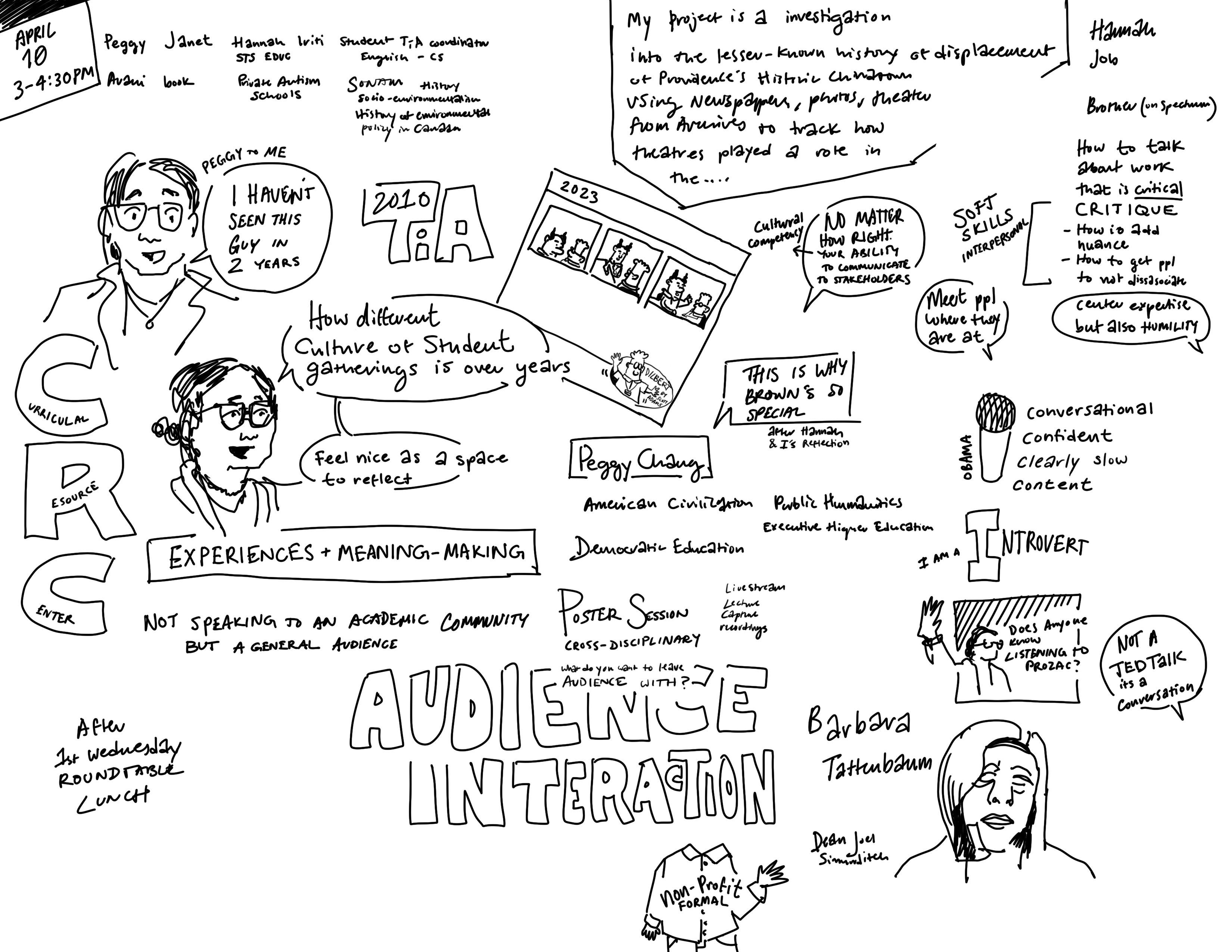
(Credit:  Aidan Choi’26, sketched during the TiA presenter training on April 10, 2026)

At Brown, where our dynamic Open Curriculum causes the academic landscape to shift with every new cohort, 2010 is ancient history. It was then that TiA was born—originally designed as a forum for seniors to showcase their capstone experiences as they became integrated requirements across the curriculum.

Fast forward to today: many concentrations now host their own dedicated opportunities for students to present their final work. This year, the TiA Production Team at the CRC has embraced this shift as an opportunity to pivot the symposium toward the CRC’s core purpose: fostering interdisciplinary learning, championing peer education, and participating in the art of reflection about the "how" of education.

A singular, powerful goal drives the evolution of TiA 2026: not only to celebrate our accomplishments, but to make learning visible for others. In traditional academic symposia, the focus is almost exclusively on the "finished product"—the polished thesis, the final data set, or the completed project. TiA 2026 invites students to pull back the curtain. We want to see the messy, rewarding, and transformative journey that happens before the finish line. This year, we are specifically highlighting:

- Interdisciplinary Scholarship: Exploring how disparate fields of study collide to create entirely new understandings.
- Peer Education: Highlighting the impact of advising, coaching, and mentoring as a vital force within the student community.
- The Learning Journey: Reflection on the methods and experiences—both academic and personal—that shape a student's intellectual path.

While the "TED Talk" format has become the gold standard for public speaking (and one of our presenters delivered an extremely popular one), TiA carves out a space for public reflection and dialogue across experiences and areas of expertise.

By centering the learning process, the symposium aims to create a living archive of the Brown experience. It’s an opportunity for students to not just present their findings but also share the pivots, sorrow, and collaborative breakthroughs that truly define scholars and leaders.

Whether you are a senior finishing a capstone, a peer-advisor helping others navigate their paths, or an underclassman experimenting with interdisciplinary work, your journey belongs at TiA 2026.

At the CRC, we’ve encouraged MAPS mentees and other sophomores to attend. To the audience members (in person or virtual): please leave a comment in the Audience Blog about any of the Symposium Blog posts or presentations, or provide anonymous specific feedback in the TiA Feedback Form. Many thanks to the TiA Advisory Circle and partners for helping us more broadly communicate this year’s TiA iteration. The Open Curriculum and the individual learning journeys would not be possible without Brown's incredible faculty.

Congratulations, members of the Class of 2026!

Leave a comment.

Back to Blog list
 Theories in Action